KIARVA - Mapping global variation in immune receptor genes
March 26, 2026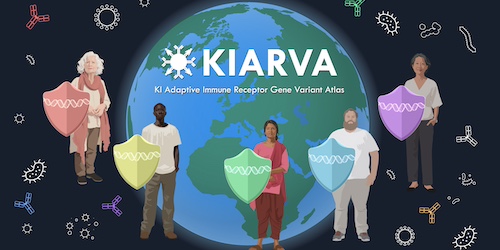
The KI Adaptive Immune Receptor Gene Variant Atlas (KIARVA) is a new open resource that maps variation in adaptive immune receptor genes across global populations. It is a collaboration between Karolinska Institutet (KI) and SciLifeLab Data Centre (DC); KI generated and analysed the data, whilst DC hosts the data and provides access via a custom-built web application.
Adaptive immune responses mediated by B- and T-cells are essential for protection against infections. The genomic regions encoding these receptors are highly complex and have been difficult to resolve using standard sequencing approaches. As a result, genetic variation in these regions has been poorly characterised, with existing reference datasets largely biased toward individuals of European ancestry.
To address this challenge, Gunilla Karlsson Hedestam (Research Group Leader at the Department of Microbiology, Tumor and Cell Biology (MTC) at Karolinska Institutet and SciLifeLab) and Martin Corcoran (Head of Immunogenetics) and their team developed the ImmuneDiscover technique. The technique was designed to identify inherited variants in B- and T-cell receptor genes with nucleotide-precision accuracy. The team applied this approach to DNA samples from 2,486 individuals representing 25 population ancestries. The resultant dataset underpins KIARVA.
KIARVA provides open access to a wide range of data, including germline variable (V), diversity (D), and joining (J) allele sequences, as well as population-specific allele frequencies across five continental groups and 25 subpopulations. It also includes search and comparison tools that allow researchers to identify whether alleles observed in their own data are already represented in KIARVA.
By making population-resolved germline variation openly available, KIARVA supports more accurate immunogenetics research, including antibody studies and immune repertoire analyses. It also enables studies of how inherited variation in adaptive immune genes influences responses to infections, vaccines, allergens, and autoimmune diseases.
Visit KIARVA to find out more about how it could accelerate research into adaptive immunity, and improve how immune-related diseases are studied and treated.